الى المؤلفين
1. About the Journal
For an overview of the journal, including its mission, aims and scope, publication policies, and archiving information, please visit the Academic International Journal of Social Sciences and Humanities (AIJSSH) Homepage
2. Guidelines
- AIJSSH accepts submissions of scholarly works written in English or Arabic.
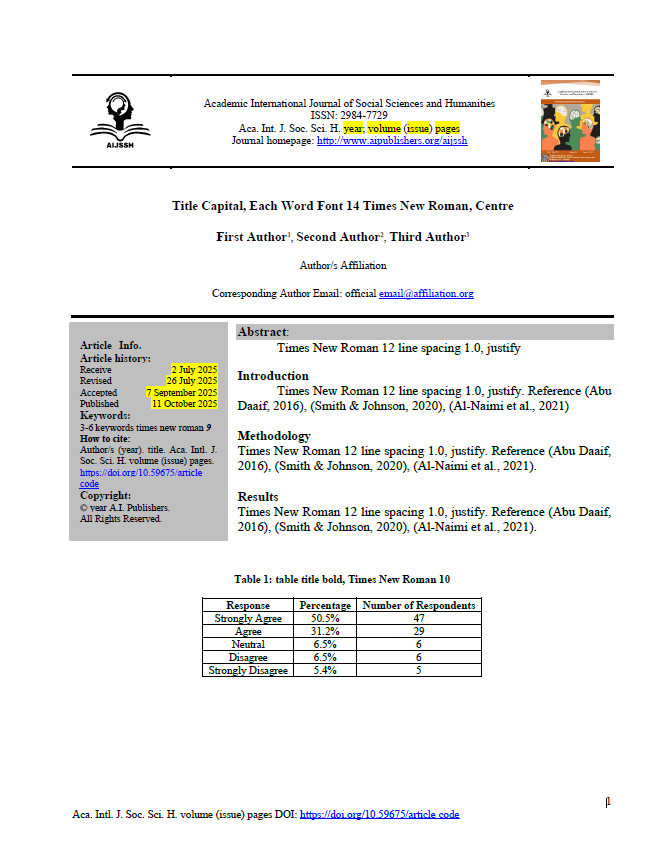
- Manuscripts must be prepared using a recent version of Microsoft Wordand saved in .docx The text should be presented in a single-column layout and formatted according to the journal's template.
- Authors are encouraged to use the spelling and grammar checking toolsavailable in their word-processing software before submission to minimize language and formatting errors.
- Manuscripts must be original, unpublished, and not under consideration
- The manuscript should generally not exceed 7,000 words (excluding references) unless prior approval is obtained from the Editor-in-Chief. The word limit applies only to the initial submission. Revised manuscripts submitted in response to reviewers' comments may exceed the word limit.
- Arabic manuscripts should use Simplified Arabic font, while manuscripts written in English should use Times New Roman.
- Authors should ensure consistency in formatting, headings, tables, figures, and references throughout the manuscript.
3. Ethics and policies
- Authors must follow the ethical guidelines stated below.
3.1.1. Authorship
- All authors must make significant scientific contributions.
- Every author must approve the final manuscript.
- All authors share responsibility for the published work.
- Only one corresponding author communicates with the journal.
- Finalize the author list before submission.
- Authorship changes require editor approval before acceptance only.
- No authorship changes are permitted after acceptance.
3.1.2. Funding Statement
Authors must clearly disclose and acknowledge all sources of funding, sponsorship, or financial support related to the research.
3.1.3. Language and editing services
- We recommend that you write in American or British English but not a combination of both.
- If you feel the English language in your manuscript requires editing to eliminate possible grammatical or spelling errors and to conform to correct scientific English, you may wish to use the English Language Editing service provided by Academic International Publishers.
3.1.4. Copyright and Licensing
- Authors retain copyright of their published work while granting the journal the right to publish and distribute the manuscript.
- All published articles are distributed under the Creative Commons Attribution 4.0 International License (CC BY 4.0).
3.1.5. Conflict of Interest
Where applicable, authors should disclose any conflicts of interest that may influence the research or its interpretation. This includes, but is not limited to, funding from governmental or private entities that may benefit from the research findings; employment, consultancy, or advisory relationships with organizations related to the study topic; financial interests such as share ownership or employment in institutions connected to the research outcomes; situations in which researchers evaluate or study institutions where they are employed, if such circumstances could affect the objectivity of the results; and any personal or professional relationships that may influence the interpretation of the findings. If there are no conflicts of interest, authors are encouraged to state: “The authors declare no conflict of interest.”
3.1.6. Article Processing Charges (APCs)
- Article Processing Charge USD 250(or equivalent)
- Payable only after formal acceptance
- No submission or peer-review fees
- Optional fast-track publishing and editing services are available for an additional fee
3.1.7. Fast Track Publishing
AIJSSH offers an optional Fast Track Publishing Service for authors requiring expedited editorial processing. Fast-track submissions undergo the same academic and ethical review standards as regular submissions.
Fast-track processing does not guarantee acceptance for publication.
3.1.8. DOI and Archiving Policy
Each published article is assigned a Digital Object Identifier (DOI) to ensure permanent identification and citation.
AIJSSH participates in LOCKSS archiving systems to ensure long-term preservation and accessibility of published content.
3.1.9. Peer Review Process
AIJSSH follows a double-blind peer-review process. Each manuscript is evaluated by independent reviewers based on originality, methodological rigor, academic relevance, and contribution to knowledge.
3.1.10. Withdrawal, correction or retraction
- Editor's Note: Minor issue; results remain valid.
- Expression of Concern: Possible issue under investigation.
- Withdrawal: For unpublished final versions released by mistake.
- Retraction: Serious scientific or ethical problems make the article unreliable.
- Removal: Only for exceptional legal or public safety reasons.
- Replacement: Retracted article is replaced with a corrected version.
- Archive: All article versions are permanently preserved.
4. Submission System
All manuscripts must be submitted electronically through the journal’s Open Journal System (OJS).
4.1.1. Required Submission Files
- Main manuscript (Mandatory): Submit the full manuscript prepared for anonymous peer review, without author name(s) or affiliation(s). All figures and tables should be editable and included within the manuscript and placed in their appropriate positions.
- Author/s Information File (Mandatory): Submit a separate file including the author(s)' name(s), affiliation(s), email address(es), and ORCID iD(s).
- Cover Letter (If required): Submit a cover letter when requested by the Editor or required by the journal.
- Similarity and AI Writing Reports (Recommended): Attach a similarity report (similarity index below 20%) and an AI writing report (An AI writing report is recommended for transparency. Excessive AI-generated text that compromises the originality or integrity of the manuscript may result in rejection), preferably generated using Turnitin, as supplementary files with the manuscript submission.
4.1.2. Submission Steps
- Register and then log in to the OJS system
- Start a new submission
- Agree to journal policies and ethical standards
- Enter manuscript metadata
- Upload required files
- Review and confirm submission
5. Manuscripts Structure
5.1.1. Numbering
- The use of numbering for main section headings is optional. However, if section numbering is adopted, it should be applied consistently throughout the manuscript. Subsections should always follow a hierarchical numbering system (e.g., 2.1, 2.2, 2.2.1) to ensure a clear and logical organization of the manuscript.
- The Abstract and References should not be numbered.
5.1.2. Tables and Figures
Tables and figures should be editable and numbered consecutively according to their order of appearance in the manuscript.
- Table titles should appear above the table.
- Figure captions should appear below the figure.
- All tables and figures must be clearly presented, appropriately labelled, and cited within the text.
5.1.3. Title:
The title should be clear, concise, accurate, and informative, providing readers with an immediate understanding of the study's focus. It should accurately reflect the manuscript's content and include relevant keywords to improve indexing and discoverability. Avoid unnecessary words, jargon, unexplained abbreviations, and exaggerated or unsupported claims. Authors are encouraged to use specific terms that clearly represent the research topic, population, context, or key variables, where appropriate.
5.1.4. Author Names and Affiliations
- Authors should provide their official names exactly as they appear in their Google Scholar and Scopus profiles (where available) and ensure that all names are spelled correctly. The affiliation(s) where the research was conducted should be listed below the author names. If an author has more than one affiliation, all affiliations should be provided.
- Affiliations should be presented in the following order: Department or Division, College or Faculty, University or Institution, Country.
- Authors should also provide their e-mail address, preferably an official institutional e-mail address, and their ORCID iD.
- The corresponding author should be identified with an asterisk (*) immediately after their name. The corresponding author is responsible for all communication with the journal during the review, publication, and post-publication stages. To ensure that author names, affiliations, and correspondence details are presented correctly, authors are advised to follow the format used in articles previously published in the journal.
5.1.5. Abstract and Keywords
5.1.6. Abstract
All manuscripts must include abstracts in both English and Arabic containing identical information. The abstract should be between 150 and 300 words and should be structured using the following subheadings:
-
Objectives
State clearly the main purpose of the study and the research problem being addressed. The objectives should explain why the study was conducted and what it seeks to achieve.
-
Methods
Briefly describe the research design, methodology, data collection methods, sample (where applicable), and analytical techniques used to achieve the study objectives.
-
Results
Summarize the principal findings of the study. Results should be presented clearly and accurately, highlighting the most significant outcomes without interpretation or exaggeration.
-
Conclusions
Present the main conclusions derived from the findings of the study and, where appropriate, include the practical, theoretical, or policy implications and key recommendations.
The abstract should accurately reflect the content of the manuscript and should not contain references, citations, footnotes, tables, figures, or unexplained abbreviations.
5.1.7. Keywords
- Keywords: Provide 3–5 specific and relevant keywords that accurately reflect the content of the manuscript. Keywords should be included in the Article Information section in the manuscript.
- Keywords should be specific, relevant, and suitable for indexing and retrieval purposes. Authors should avoid overly general terms, plural expressions, multiple concepts within a single keyword, and unnecessary abbreviations. Only abbreviations that are well established and widely recognized within the relevant field may be used.
5.1.8. Introduction
The Introduction should clearly present the research problem, objectives, significance of the study, and relevant background. It should provide sufficient context for understanding the study while avoiding an extensive review of the literature or a summary of the study results.
5.1.9. Methods
Authors should provide sufficient detail to enable readers to understand how the study was conducted and to evaluate the validity and rigor of the research. Previously published methods should be summarized and supported by appropriate references.
5.1.10. Results
Results should be presented clearly, accurately, and concisely. Findings should be reported in a logical sequence and supported, where appropriate, by tables and figures.
5.1.11. Discussion
The Discussion should interpret and explain the significance of the findings in relation to the research objectives and existing literature. It should highlight the contribution of the study, discuss its implications, and acknowledge any relevant limitations. Repetition of results should be avoided.
Where appropriate, authors may combine the Results and Discussion sections.
5.1.12. Conclusions
The Conclusions section should summarize the principal findings of the study and their implications. Where appropriate, authors may also include recommendations for future research, policy, or practice. The Conclusions may be presented as a separate section or as part of the Discussion section.
5.1.13. Footnotes
This journal does not publish footnotes. Authors should incorporate essential information into the main text whenever possible and avoid the use of footnotes throughout the manuscript.
5.1.14. Acknowledgements
Authors may acknowledge individuals, institutions, or organizations that contributed to the research but do not qualify as authors. Technical, editorial, or financial support should also be acknowledged where appropriate.
5.1.15. References
5.1.16. References and In-Text Citations (APA 7th Edition)
All in-text citations and references must conform to the Publication Manual of the American Psychological Association (APA), 7th Edition.
5.1.17. In-Text Citations
- Use the author–date citation format (Author, Year) throughout the manuscript.
- Page number(s) must be provided for all direct quotations.
- Page numbers are also recommended when referring to a specific page, section, paragraph, table, figure, or chapter of a source.
5.1.18. Reference List
- Arrange all references alphabetically by the surname of the first author.
- Arrange multiple works by the same author(s) chronologically according to the year of publication.
- Distinguish works published in the same year by the same author(s) using lowercase letters (e.g., 2023a, 2023b).
- Ensure that every source cited in the text appears in the reference list, and that every reference listed has been cited in the text.
5.1.19. Reference Accuracy
Authors are responsible for ensuring that all references are:
- Accurate
- Complete
- Authentic
- Relevant to the manuscript.
- Retrievable by readers.
- Formatted in accordance with APA 7th Edition.
Where available, authors should include and verify Digital Object Identifiers (DOIs), URLs, and other persistent identifiers for all cited references. DOIs should be presented in URL format (e.g., https://doi.org/xxxxx).
5.1.20. Examples of References
The following examples illustrate the reference style required by the journal in accordance with the Publication Manual of the American Psychological Association (APA), 7th Edition. For additional reference types and detailed guidance, authors are encouraged to consult the official APA Style resources.
5.1.20.1. Official APA Resources
5.1.20.2. Journal Article
Raed H. Ogaili, & Layla Albadri. (2025). How to Write an Academic Article: Focusing on Research Elements and Structural Components. Academic International Journal of Social Sciences and Humanities, 3(1), 01-08. https://doi.org/10.59675/S311
5.1.20.3. Book/E-book References
Jackson, L. M. (2019). The psychology of prejudice: From attitudes to social action (2nd ed.). American Psychological Association. https://doi.org/10.1037/0000168-000
5.1.20.4. Chapter in an Edited Book
Parenthetical citation of a chapter of an authored book: (McEwen & Wills, 2014, Chapter 16, p. 363)
5.1.20.5. Conference Session
Evans, A. C., Jr., Garbarino, J., Bocanegra, E., Kinscherff, R. T., & Márquez-Greene, N. (2019, August 8–11). Gun violence: An event on the power of community [Conference presentation]. APA 2019 Convention, Chicago, IL, United States. https://convention.apa.org/2019-video
5.1.20.6. Published Dissertation or Thesis
Kabir, J. M. (2016). Factors influencing customer satisfaction at a fast-food hamburger chain: The relationship between customer satisfaction and customer loyalty (Publication No. 10169573) [Doctoral dissertation, Wilmington University]. ProQuest Dissertations & Theses Global.
5.1.21. Getting help and support
For assistance regarding manuscript submission, publication policies, or the editorial process, please contact:
Editor-in-Chief: aijssh@aipublishers.org
Editing and Language Services: edit@aipublishers.org
Publication and General Inquiries: info@aipublishers.org