Submissions

Login or Register to make a submission.

Author Guidelines

  • The journal accepts manuscripts written in Arabic or English.
  • The manuscript must not exceed 7,000 words. Any submission exceeding this limit requires prior approval from the Editorial Board before submission.
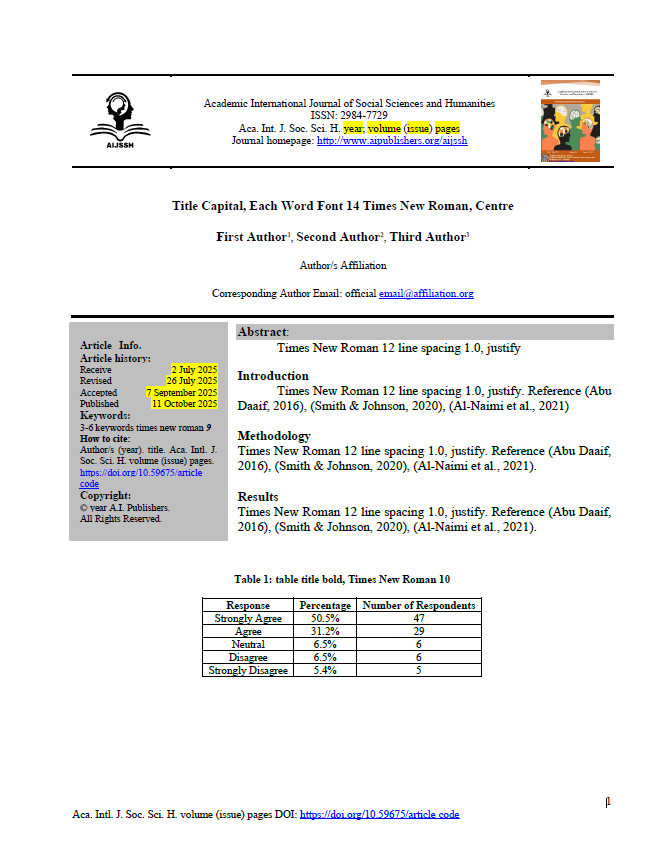
  • Authors are required to strictly follow the instructions and formatting guidelines provided in the official journal template. To download the template, please visit the journal's website.

Authors are requested to organise their manuscripts according to the following structure:

First: Content in English

  • Title of the Manuscript
    (Clear, concise, and accurately reflecting the main variables or concepts of the study)
  • Author (s’ Name(s), including the affiliated university or academic institution and its location
  • Abstract
  • Keywords

Second: Content in Arabic

  • Title of the Manuscript
  • Author (s’ Name(s), including the affiliated university or academic institution and its location
  • Abstract
  • Keywords

Abstracts (Arabic and English)

Each manuscript must include two abstracts:

  • One abstract written in English.
  • One abstract written in Arabic.

The information presented in both abstracts must be fully identical in content. Abstracts must comply with the following requirements:

Abstract Writing Requirements

  • The abstract should range between 150 and 350 words.
  • It should provide a comprehensive summary of the entire manuscript, typically presented in a single paragraph.
  • The language must be clear, concise, precise, and carefully edited.
  • The abstract should be self-contained, allowing readers to understand the study without referring to the full text.
  • Abstracts are generally written in the past tense and in the third person.

Abstract Structure

The abstract should include the following core elements, presented in a logical and coherent sequence:

  1. Rationale for the Study
    What is the significance of the topic? Why is research worthy of attention from readers or the academic community?
  2. Research Problem
    What is the main problem or research question addressed by the study?
  3. Methodology
    A brief description of the research design, methods, procedures, and types of data or evidence used to reach the findings.
  4. Results
    A concise and clear presentation of the main findings, with the possibility of referencing specific data or summarising results where appropriate.
  5. Recommendations
    What recommendations or implications arise from the findings, and how does the study contribute to advancing knowledge in the field?

Third: Keywords

Authors are required to provide three (3) to six (6) keywords or short, precise phrases that accurately reflect the topic and core themes of the manuscript. Keywords are essential for effective indexing and retrieval of the article in academic databases.

Fourth: Introduction

The introduction should clearly and precisely present the research problem and explain the study’s theoretical and practical significance. It should include a concise review of relevant literature that highlights the existing knowledge gap the study seeks to address. This section should clearly state the research objectives, research questions, and/or hypotheses, providing readers with a coherent overview of the study’s scope and direction.

Fifth: Theoretical Framework and Literature Review

This section should present a structured discussion of the key concepts, theories, and models relevant to the research topic. It should also provide a systematic review of major prior studies, clearly demonstrating how they relate to the research problem and highlighting the original contribution of the current study relative to the existing literature.

Sixth: Methodology

  1. Research Design

Authors should specify the research design adopted in the study (e.g., descriptive, analytical, experimental, qualitative, mixed methods, etc.), providing a clear justification for the selection of this design in relation to the research problem and objectives.

  1. Population and Sampling Procedure

This subsection should describe the target population of the study and explain the sampling technique employed (probability or non-probability sampling). Authors must report the sample size and outline the key demographic or contextual characteristics of the sample.

  1. Data Collection Instruments

Authors should describe the instruments used for data collection (e.g., questionnaires, interviews, observations, records, tests). This section must include:

  • A detailed description of each instrument and its components.
  • Procedures used to establish validity and reliability (or trustworthiness, in qualitative studies).
  • The method of instrument administration and the procedures followed for data collection.

Seventh: Results

The results of the study should be presented clearly and accurately using appropriate formats, including:

  • Narrative (textual) presentation,
  • Tables,
  • Figures or graphs, where applicable.

Authors must ensure that:

  • Tables and figures are numbered consecutively.
  • Each table or figure is accompanied by a clear and concise title.
  • A brief explanatory description is provided before or after each table or figure, as appropriate.
  • Tables and figures should be embedded within the main text at appropriate locations.
  • Table titles must appear above the tables, while figure captions should be placed below the figures.

Eighth: Discussion

The discussion section should interpret the findings considering:

  • Relevant theories and previous literature,
  • The research objectives and/or hypotheses,
  • The broader scientific or applied context of the study.

This section should also address the theoretical and practical implications of the findings and acknowledge the study's methodological limitations, including constraints related to the research instruments, sample characteristics, and contextual conditions.

Ninth: Conclusions and Recommendations

Conclusions

This subsection should provide a concise synthesis of the study’s main findings without repeating data or tables verbatim.

Recommendations

Authors should present clear, specific, and actionable recommendations derived from the study’s findings. These recommendations may be directed toward researchers, practitioners, institutions, or policymakers, depending on the nature and scope of the study.

Tenth: Limitations and Future Research Directions

This final section should include:

  • A brief overview of the key limitations encountered during the research process.

Well-founded suggestions for future research that address unexplored aspects of the topic or expand upon the scope of the current study.

Submission Preparation Checklist

All submissions must meet the following requirements.

  • This submission meets the requirements outlined in the Author Guidelines.
  • This submission has not been previously published, nor is it before another journal for consideration.
  • All references have been checked for accuracy and completeness.
  • All tables and figures have been numbered and labeled.
  • Permission has been obtained to publish all photos, datasets and other material provided with this submission.

Articles

Section default policy

Privacy Statement


1. Information Collected

The journal may collect personal information such as names, institutional affiliations, email addresses, and other contact details provided during user registration, manuscript submission, peer review, or editorial correspondence.

2. Purpose of Data Use

Personal information is collected and used exclusively for the following purposes:

  • Managing manuscript submissions and peer review processes
  • Editorial decision-making and publication activities
  • Communication between authors, reviewers, editors, and journal staff
  • Indexing, archiving, and dissemination of published articles

3. Data Confidentiality and Security

All personal data are treated as confidential and are stored securely. The journal takes reasonable technical and organizational measures to protect personal information from unauthorized access, disclosure, alteration, or misuse.

4. Data Sharing

Personal information will not be shared, sold, or disclosed to third parties for commercial or non-journal purposes. Data may be shared only when required for legitimate journal operations (e.g., publishing metadata) or when legally required.

5. Author and Reviewer Rights

Authors, reviewers, and registered users have the right to:

  • Access their personal data
  • Request correction or update of inaccurate information
  • Request removal of their personal data, where applicable

6. Cookies and Website Analytics (Optional)

The journal website may use cookies or basic analytics tools to improve user experience and website functionality. No personally identifiable information is collected through these tools.

7. Consent

By registering with or submitting to the journal, users consent to the collection and use of their personal information in accordance with this Privacy Statement.

8. Policy Updates

The journal reserves the right to update this Privacy Statement as needed. Any changes will be published on the journal website.