For Author
1. Author Guidelines
The journal accepts manuscripts written in Arabic or English.
The manuscript must not exceed 7,000 words. Any submission exceeding this limit requires prior approval from the Editorial Board before submission.
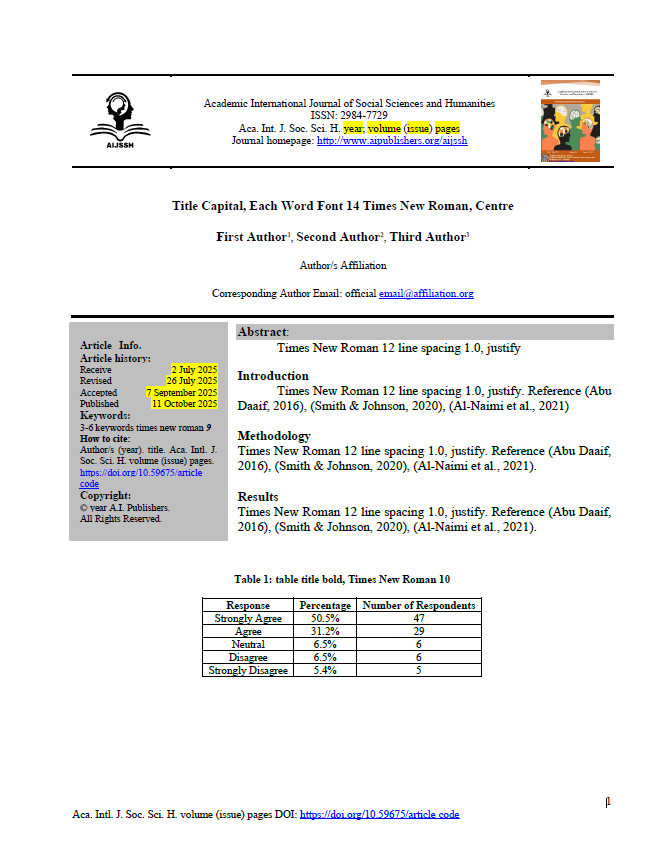
Authors are required to strictly follow the instructions and formatting guidelines provided in the official journal template. To download the template, please visit the journal's website.
Authors are requested to organise their manuscripts according to the following structure:
First: Content in English
- Title of the Manuscript (Clear, concise, and accurately reflecting the main variables or concepts of the study)
- Author(s) Name(s), including the affiliated university or academic institution and its location
- Abstract
- Keywords
Second: Content in Arabic
- Title of the Manuscript
- Author(s) Name(s), including the affiliated university or academic institution and its location
- Abstract
- Keywords
Abstracts (Arabic and English)
Each manuscript must include two abstracts:
- One abstract written in English.
- One abstract written in Arabic.
The information presented in both abstracts must be fully identical in content. Abstracts must comply with the following requirements:
Abstract Writing Requirements
- The abstract should range between 150 and 350 words.
- It should provide a comprehensive summary of the entire manuscript, typically presented in a single paragraph.
- The language must be clear, concise, precise, and carefully edited.
- The abstract should be self-contained, allowing readers to understand the study without referring to the full text.
- Abstracts are generally written in the past tense and in the third person.
Abstract Structure
The abstract should include the following core elements, presented in a logical and coherent sequence:
- Rationale for the Study: What is the significance of the topic? Why is research worthy of attention from readers or the academic community?
- Research Problem: What is the main problem or research question addressed by the study?
- Methodology: A brief description of the research design, methods, procedures, and types of data or evidence used to reach the findings.
- Results: A concise and clear presentation of the main findings, with the possibility of referencing specific data or summarising results where appropriate.
- Recommendations: What recommendations or implications arise from the findings, and how does the study contribute to advancing knowledge in the field?
Third: Keywords
Authors are required to provide three (3) to six (6) keywords or short, precise phrases that accurately reflect the topic and core themes of the manuscript. Keywords are essential for effective indexing and retrieval of the article in academic databases.
Fourth: Introduction
The introduction should clearly and precisely present the research problem and explain the study’s theoretical and practical significance. It should include a concise review of relevant literature that highlights the existing knowledge gap the study seeks to address. This section should clearly state the research objectives, research questions, and/or hypotheses, providing readers with a coherent overview of the study’s scope and direction.
Fifth: Theoretical Framework and Literature Review
This section should present a structured discussion of the key concepts, theories, and models relevant to the research topic. It should also provide a systematic review of major prior studies, clearly demonstrating how they relate to the research problem and highlighting the original contribution of the current study relative to the existing literature.
Sixth: Methodology
Research Design: Authors should specify the research design adopted in the study (e.g., descriptive, analytical, experimental, qualitative, mixed methods, etc.), providing a clear justification for the selection of this design in relation to the research problem and objectives.
Population and Sampling Procedure: Describe the target population and explain the sampling technique employed (probability or non-probability sampling). Report the sample size and outline key demographic or contextual characteristics.
Data Collection Instruments:
- A detailed description of each instrument and its components.
- Procedures used to establish validity and reliability (or trustworthiness, in qualitative studies).
- The method of instrument administration and procedures followed for data collection.
Seventh: Results
The results of the study should be presented clearly and accurately using appropriate formats, including:
- Narrative (textual) presentation
- Tables
- Figures or graphs, where applicable
Authors must ensure that:
- Tables and figures are numbered consecutively.
- Each table or figure is accompanied by a clear and concise title.
- A brief explanatory description is provided before or after each table or figure, as appropriate.
- Tables and figures should be embedded within the main text at appropriate locations.
- Table titles must appear above the tables, while figure captions should be placed below the figures.
Eighth: Discussion
The discussion section should interpret the findings considering:
- Relevant theories and previous literature
- The research objectives and/or hypotheses
- The broader scientific or applied context of the study
This section should also address the theoretical and practical implications of the findings and acknowledge the study's methodological limitations, including constraints related to research instruments, sample characteristics, and contextual conditions.
Ninth: Conclusions and Recommendations
Conclusions
This subsection should provide a concise synthesis of the study’s main findings without repeating data or tables verbatim.
Recommendations
Authors should present clear, specific, and actionable recommendations derived from the study’s findings. Recommendations may be directed toward researchers, practitioners, institutions, or policymakers, depending on the nature and scope of the study.
Tenth: Limitations and Future Research Directions
- A brief overview of the key limitations encountered during the research process.
- Well-founded suggestions for future research that address unexplored aspects of the topic or expand upon the scope of the current study.
2. Ethical Requirements
Details about this section in this link: Ethics
3. Submission System
3.1 Online Submission
All manuscripts must be submitted through the Open Journal Systems (OJS) platform.
3.2 Required Files
- Main manuscript file (anonymous for peer review)
- Author information file
- Cover letter or statement of originality (if required)
- Figures, tables, and supplementary materials (if applicable)
- Plagiarism and AI reports based on Turnitin software
3.3 Submission Steps
- Register or log in to the OJS system
- Start a new submission
- Agree to journal policies and ethical standards
- Enter manuscript metadata
- Upload required files
- Review and confirm submission
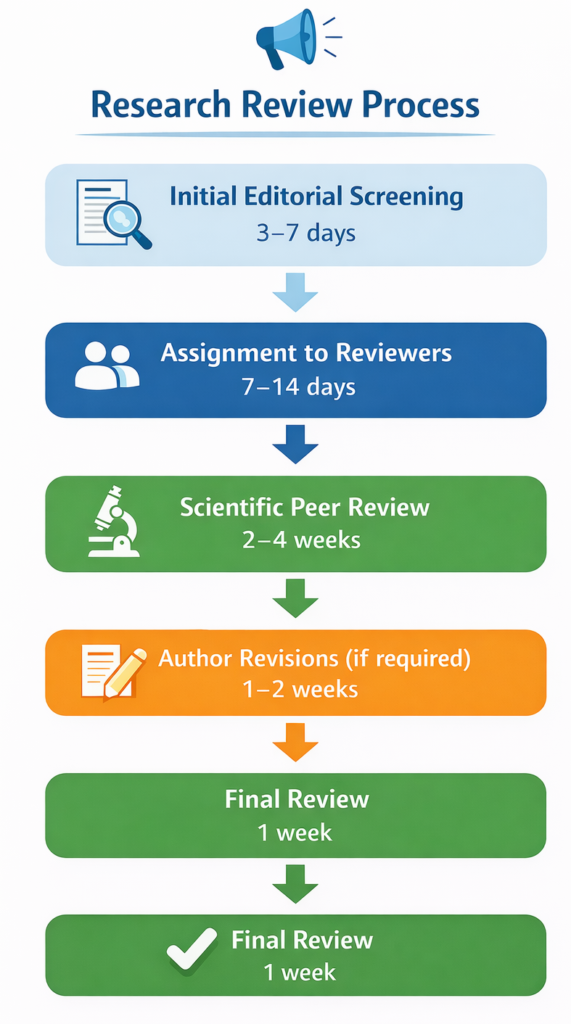
4. Peer Review Process and Timeline
Details about this section in this link: Peer Review
5. Copyright and Licensing
Copyright ©2023 Academic International Journal of Social Sciences and Humanities
All submitted and published works in this journal are the intellectual property of the authors. By submitting a manuscript, authors retain copyright while granting the journal the right to publish and distribute the work.
Creative Commons License
This work is licensed under a Creative Commons Attribution 4.0 International License, allowing others to share, copy, redistribute, and adapt the work, provided proper credit is given to the original authors and the journal.
6. Article Processing Charges (APCs)
- Publication fee: USD 250 (or equivalent)
- Payable only after formal acceptance
- No submission or peer-review fees
- Optional Fast Track Publishing and editing services is available for an additional fee
6.1 Publication Fee Waivers
The journal offers publication fee waivers in accordance with clearly defined and transparent criteria. As part of its commitment to promoting academic excellence and fostering inclusivity in scholarly publishing, the journal allocates a limited number of articles in each volume to be published without any publication fees. This initiative aims to support high-quality research and encourage submissions from authors who may face financial constraints that prevent them from covering publication costs.
Authors wishing to apply for a publication fee waiver are required to submit a formal request through the designated electronic application form available on the journal’s official website. All waiver requests are subject to a thorough evaluation by the Editorial Board, based on academic merit and adherence to the journal’s established editorial standards. The outcomes of waiver applications are announced through the journal’s official online platforms.
The journal emphasizes that the granting of a publication fee waiver has no impact whatsoever on the integrity of the peer-review process, the independence of editorial decisions, or the criteria governing acceptance and publication.
Download Publication Fee Waiver Form
7. Fast Track Publishing Policy
To accommodate authors who require expedited publication due to academic, professional, or institutional deadlines, AIJSSH offers a Fast Track Publishing Service. This service accelerates the editorial and peer-review process while maintaining the same rigorous academic standards as for regular submissions.
Scope and Conditions
- Manuscripts submitted under the Fast Track option undergo full double-blind peer review and are evaluated according to the journal’s established quality and ethical standards.
- Authors opting for this service are required to respond promptly to editorial and reviewers’ comments and submit revisions within the specified timeframe.
- Fast Track processing does not guarantee acceptance; manuscripts may still be rejected if they fail to meet the journal’s academic requirements.
- An additional fee applies for the Fast Track service, separate from the standard publication fee, and is payable upon acceptance.
- The Fast Track service prioritises the manuscript in editorial handling and review scheduling, without compromising the integrity, objectivity, or quality of the peer review process.